The Final Problem Ending Explained: Netflix Series vs. Arturo Perez-Reverte Book Differences
Netflix’s four-part Spanish mystery miniseries The Final Problem, originally titled El problema final, arrived in September 2026 and quickly became the kind of adaptation that gives mystery fans something to argue about long after the credits roll. Directed by Felix Viscarret and led by Jose Coronado, the series adapts Arturo Perez-Reverte’s 2023 novel, a story built as both a murder mystery and a love letter to the classic detective fiction of Agatha Christie and Arthur Conan Doyle. On paper, it sounds like a straightforward locked-room mystery. It isn’t quite that simple once the final episode starts pulling the floor out from under the audience.
The basic premise survives the move from novel to television. A group of people become trapped on an isolated Mediterranean island, a murder appears to be impossible, and an aging actor famous for playing Sherlock Holmes is forced to investigate a real crime. But the adaptation changes much more than names and locations. The Netflix version alters the period, reshapes several characters, reduces the book’s long literary discussions, and then takes the ending in a completely different direction. The result is not simply Perez-Reverte’s novel acted out on screen. It is a separate interpretation of the same mystery, particularly once the story reaches its final hour.
Greece in 1960 Becomes Mallorca in 1959
The first major change is easy to spot because it affects the entire atmosphere of the story. Perez-Reverte’s novel takes place in June 1960 on the Greek island of Corfu, at the isolated Hotel Auslander in Utakos. The location matters. The hotel feels like a temporary refuge for travelers from different countries, while the violent Mediterranean storm cuts them off from the outside world. There is a worn post-war quality to the setting, and the isolation makes every stranger in the building feel potentially important.
Netflix moves the story back slightly to the spring of 1959 and relocates it to Santa Agueda, a fictional islet off the coast of Mallorca. The basic function of the location remains the same: thirteen people are effectively trapped together, and there is nowhere for the killer to disappear. But the visual language changes considerably. The Spanish island gives the series a warmer, more cinematic setting, allowing the production to play with sunlit exteriors, old hotels, Mediterranean architecture, and a strong sense of period nostalgia.
That difference may seem cosmetic at first, but it affects the mood of the mystery. The novel’s Greece feels tied to the exhausted atmosphere of post-war Europe, while the Netflix series is more interested in the romance of old cinema and the image of a glamorous European mystery. It is one of the earliest signs that the adaptation is less concerned with reproducing the book exactly than with finding its own visual identity.
Ormond Basil Becomes Benjamin Basil
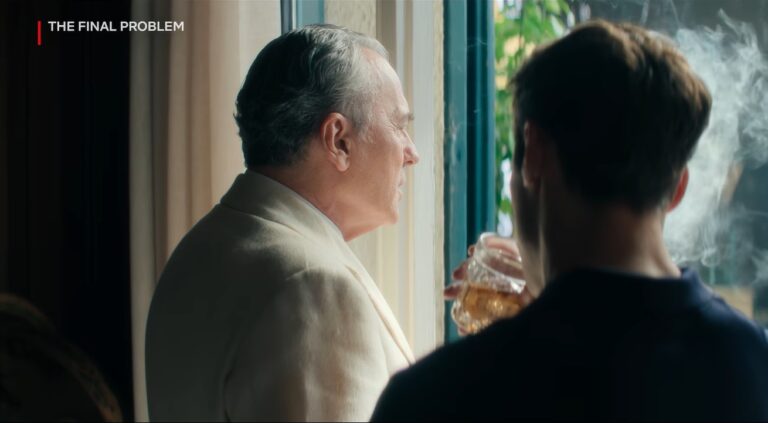
At the center of both versions is an aging Hollywood actor whose greatest role has become almost indistinguishable from his real personality. He spent years playing Sherlock Holmes, and now, when an actual murder takes place around him, the other guests naturally expect him to behave like the detective audiences once believed he was.
In the novel, that character is Ormond Basil, often called “Hopalong Basil.” The name and characterization deliberately evoke Basil Rathbone, whose screen performances helped define the popular image of Holmes for generations. Basil is accompanied by Francisco “Paco” Foxa, a pulp writer who functions as the story’s Watson figure. Their conversations are not simply about solving the murder. They are also conversations about detective fiction itself, with the novel repeatedly stopping to examine the rules, tricks, conventions, and expectations that readers bring to a mystery.
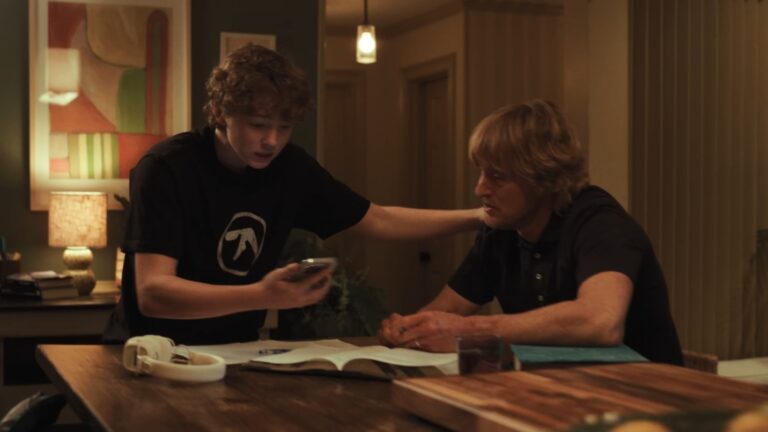
The Netflix series changes Ormond into Benjamin Basil, played by Jose Coronado, and Foxa is portrayed by Martino Rivas. The relationship remains central, but television has less patience for long literary arguments about the mechanics of mystery fiction. Those discussions are reduced, and the adaptation shifts much of the information into looks, objects, pauses, accusations, and visual clues.
That is an understandable change, although it also removes part of what made Perez-Reverte’s book distinctive. The novel is constantly aware that it is playing with detective fiction. The series still knows this, but it expresses the idea through filmmaking rather than pages of dialogue. The camera becomes part of the puzzle.
The First Murder and the Identity Swap
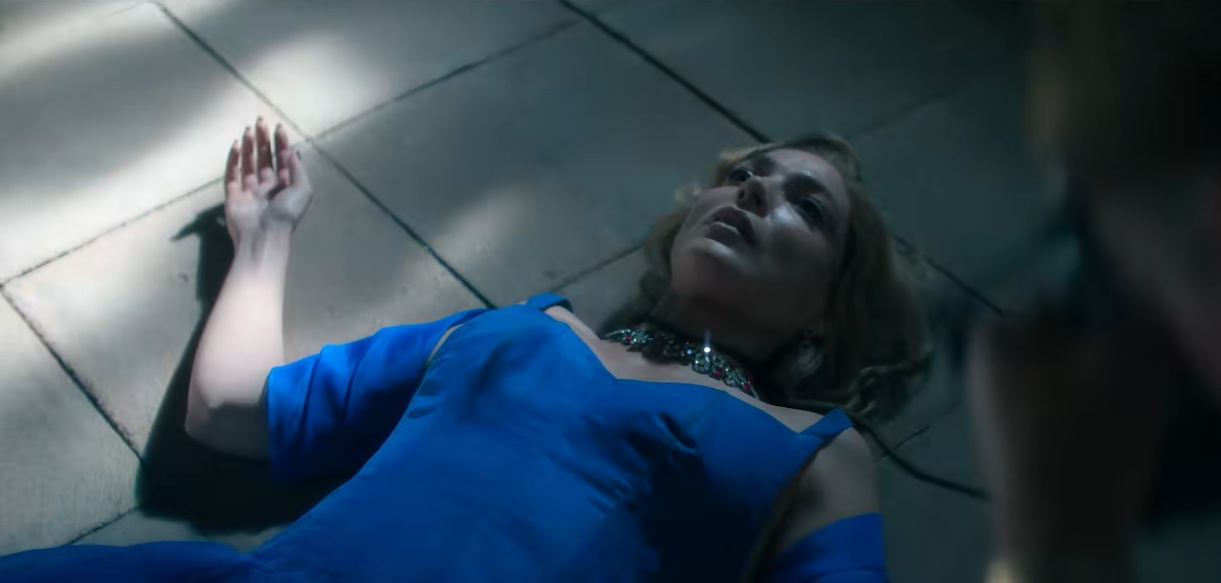
The central mystery begins in roughly the same way in both versions. A woman dies at the isolated hotel, and what initially looks like suicide soon starts to resemble something far more deliberate. From that point forward, the investigation becomes a question of identity as much as murder.
In Perez-Reverte’s novel, the first victim is Edith Mander, an English tourist. Her death is followed by those of Dr. Kemal Karabin and Hans Klemmer, a former SS officer. The deeper mystery revolves around an elaborate identity exchange. Basil eventually realizes that the woman who died was actually the real Vesper Dundas, who had been living under the stolen identity of Edith Mander. The woman known to the other guests as Vesper Dundas is, in fact, the real Edith Mander and the person responsible for the murders.
Her reasons for doing it are personal. Her revenge is connected to her husband’s execution at Gorlitz, as well as Basil himself and an old romantic abandonment. The identity trick therefore serves two purposes at once. It conceals the killer and gives the eventual confrontation a history that goes well beyond the hotel murders.
The Netflix series modifies the names and presentation of this mystery. The deceased woman is introduced as Elisa Mander, while the ensemble includes Maria Valverde as Adela Figueroa, Maribel Verdu as Mrs. Raquel Auslander, and Gonzalo de Castro as Fonseca. As Basil investigates, the apparent suicide becomes another layer of deception, and the identity of the dead woman becomes increasingly uncertain.
The important idea survives the adaptation: the person everyone thinks they understand is not necessarily that person at all. But the television version pushes the deception toward a more direct psychological confrontation. Adela’s ability to stay ahead of Basil gives the investigation a quality that recalls Irene Adler’s relationship with Holmes in A Scandal in Bohemia. She isn’t simply hiding from the detective. She understands the detective’s expectations and uses them against him.
The Ending Is Where the Adaptation Really Breaks Away
The biggest difference between the two versions comes in the final act. This isn’t a minor alteration or a few changed scenes. Netflix essentially rebuilds the conclusion around a different idea of what the story is about.

Perez-Reverte’s novel eventually moves three months beyond the events on the island, taking Basil to Lake Garda in Italy. He confronts the killer and explains how he worked out the identity swap. Yet Basil does not simply hand her over to the authorities. His decision reflects the strange moral position he has occupied throughout the novel. He is an actor who spent his life pretending to be a detective, not a police officer or judge, and the final confrontation becomes as much a psychological duel as a conventional resolution.
The novel’s ending is quiet by comparison. Basil has solved the puzzle, understood the deception, and chosen what to do with that knowledge. There is a certain irony in it. The man who spent his career portraying Sherlock Holmes is finally confronted with a real criminal and refuses to behave exactly as Holmes would.
The Netflix finale goes somewhere much stranger.
The fourth episode initially appears to move into another reality. A murder involving Klemmer is being recreated inside a hotel library, but the audience gradually realizes that this is a film set. Fonseca is producing the movie, Foxa has written it, and Basil is playing the killer. The distinction between the original murders, the investigation, and the fictional film being made from those events becomes increasingly difficult to maintain.
And that is deliberate. The series has spent four episodes asking who is lying about their identity, and the finale turns that question back onto Basil himself. He has spent most of his life playing Sherlock Holmes, and now the production around him forces him to perform another role inside a story based on his own experiences.
His relationship with Foxa has also deteriorated. The two men accuse each other over what really happened during the murders, which adds another layer of uncertainty to an already unstable situation. The audience is no longer simply asking who committed the crimes. It is asking which version of events deserves to be believed.
Adela’s Return Changes the Final Confrontation
The arrival of Adela Figueroa provides the final piece of the television adaptation’s puzzle. Basil has discovered where she is and deliberately draws her to the film set by sending a letter claiming that he has solved “the final problem” and needs her help.
Adela sees the invitation differently. She believes it gives her another chance to manipulate the situation and permanently place the blame for the real murders on Foxa. Once she arrives, the carefully constructed boundaries between Basil the actor, Basil the detective, and Basil the man begin to collapse.
This is very different from the novel’s Lake Garda confrontation. Perez-Reverte’s ending is built around deduction and moral choice, whereas the Netflix version turns the finale into a piece of theatrical deception. Characters are performing roles while discussing crimes that have already happened, and the film being produced within the story becomes another mirror for the original mystery.
The effect is intentionally self-conscious. Basil’s greatest problem is no longer just identifying the murderer. It is deciding where the performance ends. After spending decades playing Sherlock Holmes, has he become so attached to the character that the distinction between actor and detective has stopped meaning anything?
That question is much more important to the Netflix finale than it is to the novel.
Book vs. Netflix Series: The Major Differences
| Element | Arturo Perez-Reverte’s Novel | Netflix Series |
|---|---|---|
| Setting | Corfu, Greece | Santa Agueda, Mallorca |
| Time Period | June 1960 | Spring 1959 |
| Main Character | Ormond Basil | Benjamin Basil |
| Companion | Francisco “Paco” Foxa | Foxa, played by Martino Rivas |
| First Victim | Edith Mander | Elisa Mander |
| Mystery Style | Literary deduction and identity deception | Visual clues and psychological tension |
| Final Location | Lake Garda, Italy | A film set recreating the original events |
| Ending | Quiet confrontation and Basil’s moral decision | Meta-cinematic confrontation involving a movie within the story |
Why the Netflix Ending Feels So Different
A large part of the difference comes down to what each version wants the audience to think about after the mystery is solved. The book is fascinated by the machinery of detective fiction. It wants readers to recognize the references, notice the conventions being manipulated, and understand how a clever mystery can make the reader participate in the deception.
Television has fewer tools for reproducing that experience directly. A character can spend several pages discussing Conan Doyle or Christie, but on screen that can easily become static. Netflix instead turns those ideas into images. The fake film set, the actors performing scenes from the murders, Basil playing the killer, and Foxa’s involvement in the screenplay all turn the adaptation itself into part of the mystery.
That approach has its advantages, but it also changes the flavor of the story. Someone coming to The Final Problem because they enjoyed Perez-Reverte’s literary games may find the series surprisingly different. The adaptation keeps the skeleton of the mystery while replacing some of its intellectual texture with cinematic symbolism.
The fourth episode is therefore less interested in asking, “Who did it?” By that point, the more interesting question is, “Who is actually playing whom?”
How Viewers Have Responded to the Changes
The response from mystery readers and television viewers has been divided. Some fans of the novel have objected to the reduced emphasis on the long discussions of Conan Doyle, Christie, and the traditions of classic detective fiction. For those readers, those passages are not distractions from the mystery. They are part of the mystery’s identity, and the Netflix version inevitably loses some of that literary character when it converts those conversations into visual storytelling.
The ending has caused even more discussion. The film-set structure is a much more overtly meta approach than the novel’s final confrontation, and some viewers have found that change at odds with the quieter logic of the original book. The adaptation is not merely changing the location of the finale. It is changing what the finale is trying to say.
Other viewers have responded more positively to the television version’s pacing and visual style. A four-episode series cannot spend the same amount of time on literary debates as a novel, and the production uses the medium to create its own language. The movie-within-the-movie structure also gives the adaptation a way to talk about Basil’s relationship with Sherlock Holmes without simply having characters explain it.
There is no single reaction shared by everyone, and that split makes sense. The novel and the series are ultimately emphasizing different aspects of the same premise. One is more concerned with the traditions of the detective story; the other is increasingly interested in acting, identity, memory, and the strange point at which a fictional character begins to consume the person who plays him.
The Final Problem Ending Explained: Who Really Killed Elisa Mander?
Final Thoughts
The Netflix version of The Final Problem is best understood as an adaptation that takes the source material seriously without treating it as untouchable. The changes to the setting, character names, supporting cast, and mystery structure are substantial, but the most important alteration is the ending. Perez-Reverte closes his novel with a restrained confrontation that leaves Basil facing the consequences of everything he has learned. Netflix turns that confrontation into something theatrical and deliberately artificial, placing the characters inside a film that recreates their own story.
That choice makes the series feel less like a conventional detective adaptation and more like a story about an actor who has spent too long living inside the shadow of his most famous role. Benjamin Basil does solve the mystery, but the final episode suggests that solving it was never the whole point. By the time the cameras are rolling and the murders are being performed again, Basil’s identity as an actor and his identity as the detective he played have become almost impossible to separate.
And that is probably the sharpest difference between the two versions. The novel asks what happens when a fictional detective’s logic is applied to a real crime. The Netflix series asks what happens when the person who played that detective can no longer completely step outside the role.