
Even Though I’m a Super Timid Noble Girl Anime Unveils Creditless Opening and Ending Themes: Watch the Fall 2026 Otome Hits
Okay, forum, I need to talk about this. I’m usually the person who skips openings after episode two, but the creditless OP and ED for Even Though I’m a Super Timid Noble Girl, I Accepted the Bet from My Cunning Fiancé (Yowaki MAX Reijo Nano ni) dropped on October 5, and I’ve now watched them more times than I’d like to admit. This is the Fall 2026 show I didn’t know I was waiting for.
If you missed the premiere on October 4: it’s a villainess otome isekai, and yes, I know, the genre is crowded. But this one has a paleontology-obsessed heroine, and that changes everything.
Reborn as a Space Mercenary Creditless Opening and Ending Themes Released by Crunchyroll
The Setup, For Anyone Still Sleeping On It
Pia Rockwell is a minor villainess in an otome game called Caroline and the Rainbow Magic Sweets. Her scripted fate is brutal: public humiliation at the graduation party, a broken engagement, and banishment from the kingdom. Then ten-year-old Pia gets a nasty fever and wakes up with the memories of a grad student from modern Japan who was chasing a Ph.D. in paleontology.
Does she plot to steal the male leads? Grab political power? Nope. She wants to dig up fossils, open a little local museum, and quietly curate it forever. That’s it. That’s the dream. I adore her.
Her escape plan is to politely offer her fiancé, Rufus Stan, an early end to the engagement. Rufus is the proud, razor-smart son of the chancellor, and he does not take the breakup. He’s intrigued. He sees whatever is hiding under her nervous exterior and ropes her into a long-term bet about their future. Poor Pia is always ten steps behind a man who’s always ten steps ahead. Every romcom fan knows this dynamic, and here it works.
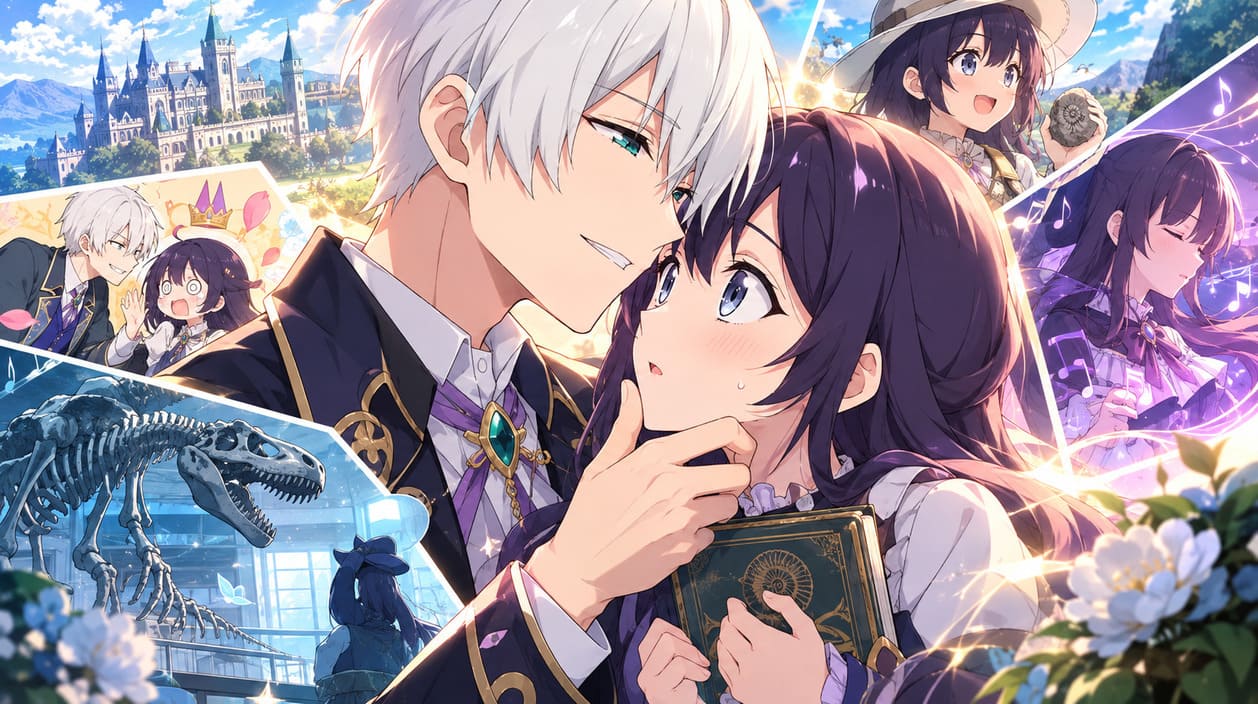
The Opening: Konomi Suzuki Does Chaos
I’ll be honest: when I saw Konomi Suzuki’s name attached to the OP, I expected something dramatic and sweeping. She’s the voice behind the Re:Zero and No Game No Life songs, after all. Instead, ‘Goki MAX Sengen’ is fast, frantic and gloriously unhinged, and it’s perfect.
Think about it. Pia is a girl who is internally screaming 24/7. The song is that scream, set to music. The tempo feels like her life spinning away from her every time Rufus makes a move. The creditless version really shows off how the animation plays Pia’s quiet, rock-loving inner world against the glittering, cutthroat court politics around her. Without the credits in the way, you can see how much care went into that contrast.
My only gripe is that it’s over too fast. I want a full-length loop of it.
The Ending: Miku Ito Wrecks Me Softly
Then there’s the ED, ‘Yoake Made ni’ (Until Dawn), sung by Miku Ito. If you know her from The Quintessential Quintuplets or Princess Connect! Re:Dive, you already know she can do tender. Here she goes quiet and vulnerable, and the whole mood flips from the OP’s comedy to something closer to a held breath.
The visuals focus on the slowly building bond between Pia and Rufus. With the text gone, you can really take in the lighting, the backgrounds, and the tiny expressions that hint Rufus’s cunning act might be covering real affection. It’s the kind of ending you let play through instead of skipping. I have feelings about a few specific frames, and I’m not going to apologize.
Who’s Behind the Screen
| Role | Name |
|---|---|
| Animation Studio | Jumondou |
| Director | Nobuaki Nakanishi |
| Series Composition | Hiroko Fukada |
| Character Design | Hyun Sik Choi |
| Music | Moe Hyuga, Natsuki Hamada |
| Original Author | Hiro Oda |
| Original Illustrator | Tsubasa.v |
Jumondou has been quietly earning a reputation for clean, expressive character work and bright color palettes, which is exactly what a high-society shojo romance needs. Nakanishi seems to understand that comedic timing and romantic tension have to share the same scene, and Fukada’s series composition keeps Pia’s inner monologues intact. Those monologues are half the charm, so please don’t cut them.
How We Got Here
This one has been a long road, and it makes the anime feel earned:
- January 2020: Hiro Oda starts the web novel on Shosetsuka ni Naro.
- August 2020: Enterbrain picks it up for print under B’s Log Bunko, with Tsubasa.v on illustrations.
- April 2024: The light novel wraps up with its seventh volume, so this is a complete story and not an endless franchise.
- Late 2025 / Early 2026: The anime gets greenlit, with Jumondou at the helm.
- October 4, 2026: Broadcast premiere in Japan.
- October 5, 2026: The creditless OP and ED go online and the fan discourse begins.
Where to Watch
It’s streaming on Crunchyroll as part of the Fall 2026 simulcast lineup, with new episodes landing shortly after the Japanese broadcast and with English subtitles. Premium tiers get you ad-free viewing and the best quality, and new users can usually grab a free trial.
The Fan Reaction (And Why I’m Not Surprised)
Reddit’s r/anime, MyAnimeList and the YouTube commentary crowd are all glowing, and I get it. People keep pointing out the mismatch between Suzuki’s high-speed OP and a heroine whose life goals are ‘ancient rocks and dinosaur bones,’ which somehow makes the whole thing more fitting. The ED is already a favorite with shojo romance blogs for its costume design and gentle framing.
Releasing clean, text-free versions right after the premiere was a smart move too. Fans can study the visual details, make GIFs, and flood social media with their favorite frames, which is exactly how a show like this finds its audience.
If you like witty romcoms, historical fantasy, or just want to watch a very anxious girl try to build a dinosaur museum in a fantasy kingdom, watch the creditless OP and ED first. Then watch episode one. This is shaping up to be my comfort anime of the autumn.


